
Caricatures
Stories of Little Brown Koko
- Title
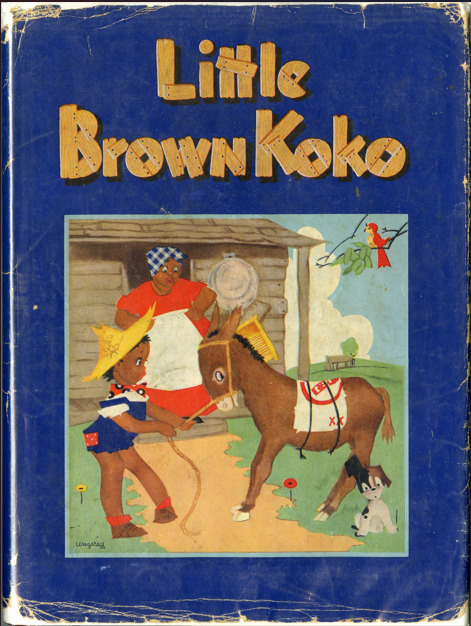
- Stories of Little Brown Koko
- Creator
- Blanche Seale Hunt
- Date Created
- 1940
- Abstract
- Blanch Seale Hunt’s wildly popular series “Little Brown Koko” was published in The Household Magazine as monthly stories from 1935 until 1950 when it was discontinued to focus more on women. During its publication the magazine also put select Koko stories into book format which sold around 600,000 copies. It’s popularity in the 1950s lead the NAACP to urge for publishing to cease on Little Brown Koko, stating it was an offensive caricature and harmful to Black youth. This copy is of the original Little Brown Koko book with a blue dust jacket, and the stories include caricature illustrations of Koko in black ink with red highlight on select items and clothes. The characters featured are Koko, his mother named “Mammy," and his dog Shoog, who are all drawn in a caricature style, exaggerating the lips and hair. Koko is illustrated as a greedy troublemaker, and a lot of the focus in the stories is on how much food Koko eats. This book is a useful source for research on the history of Children’s books and History of Black Caricature Writing.
- Source
- WorldCat
Two Runaways and Other Stories
- Title
- Two Runaways and Other Stories
- Creator
- Harry Edwards Stillwell
- Date Created
- 1900
- Abstract
- Novelist Harry Stillwell Edwards was a journalist and owner of the Macon Telegraph from Macon, Georgia, and was an avid reader despite his education being impacted by the Civil War. He was most popular for his short stories depicting Black enslaved characters written in a humorous and caricatured way. This volume features his stories “Two Runaways” and “Tom’s Strategy” that follow Black characters named Isam and Tom that are portrayed as hilarious and mischievous men. This source would be useful for research on the History of Black Caricature Writing and the History of Enslaved African American Stories.
- Source
- WorldCat
Nights with Uncle Remus: Myths and Legends of the Old Plantation
- Title
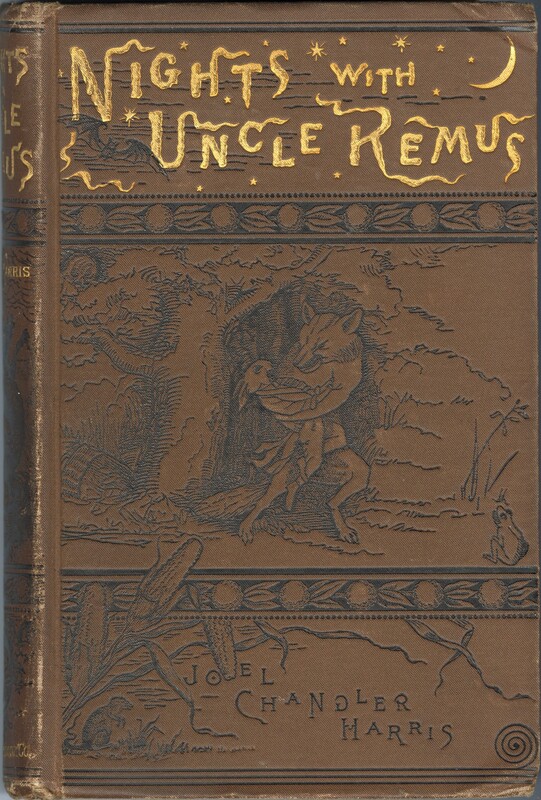
- Nights with Uncle Remus: Myths and Legends of the Old Plantation
- Creator
- Joel Chandler Harris
- Date Created
- 1881
- Abstract
- Joel Chandler Harris was a popular caricature novelist and folk tale collector and primarily focused on collecting folk tales from enslaved Black Americans. The orator of the stories, Uncle Remus, is a caricature of an old Black man (potentially an enslaved man) that was made up by Harris to give a speaker for the folk tales. The main characters that usually show up in the tales are a little white boy being told the stories; Brother Rabbit, the naïve main character in the folk tales told by Uncle Remus; and Brother Fox, the antagonist of the folk tales. These fables were intended to teach the reader about situations they might find themselves in and mistakes not to make. In 1946, the now-controversial Disney movie Song of the South was made based on the stories in Harris’s books, featuring Uncle Remus as the narrator. This book features an engraved illustration on the cover of Brother Fox kidnapping Brother Rabbit and would be useful in research on Black Folk Tales and History of Black Caricature Writing.
- Source
- WorldCat
The Confessions of Nat Turner
- Title
- The Confessions of Nat Turner
- Creator
- William Styron
- Date Created
- 1967
- Abstract
- A Pulitzer Prize winning fiction novel, The Confessions of Nat Turner by William Styron has faced a lot of public and scholarly criticism. It has also been defended by notable figures like Ralph Ellison author of Invisible Man. The novel is a fictionalized retelling of the tale of Nat Turner, an enslaved Black American who led the revolutionary Nat Turner’s Rebellion. Styron was inspired by a twenty-page pamphlet published a year after the rebellion titled “The Confessions of Nat Turner” in which Turner gave his perspective of how he came to lead the rebellion and recounted parts of his life. Styron stated that he follows the pamphlet as closely as possible, but for parts that were vague or not included Styron stated he had “allowed myself the utmost freedom of imagination in reconstructing events –yet I trust remain within the bounds of what meager enlightenment history has left us…” (preface). This is a loose caricature, and though Styron had no ill-intentions in writing Nat Turner’s story, many critics took issue with Turner being portrayed as someone who “fumbles” his way to a revolution, and the romanticization of relationships between enslavers and the enslaved. This book would be useful for research on Nat Turner (with discretion), History of Enslaved African American Stories, and history of Black Caricature Writing.
- Source
- WorldCat
Uncle Remus and Brer Rabbit
- Title
- Uncle Remus and Brer Rabbit
- Creator
- Joel Chandler Harris
- Date Created
- 1907
- Abstract
- This is part of Joel Chandler Harris’s popular Uncle Remus series, and this copy is in a story book format with a cardboard cover and fabric spine. This copy features detailed, picture book style illustrations of the stories, including illustrations of Uncle Remus, the Little Boy, Brother Rabbit (in this version “Brother” is replaced by “Brer) Brother Fox, and the other “Creeturs” in the tales. The book is also written mostly in a “slave” dialect since it is narrated by Uncle Remus. This dialect is based on the broken English that most enslaved Black Americans used at the time due to the suppression of their education and the combination of African and English language. The stories in this book are lessons on morality and character to be taught to children. This book is useful for research on the History of Black Caricature Writing and the history of Slave Folk Tales.
- Source
- WorldCat
For all Caricature Citations, see the following page: