Community Resistance
Unearthing the Roots of Resistance and Unionization
West Virginia’s rebellious spirit can be traced back to the Mine Wars, an escalating series of strikes and armed conflicts in West Virginia’s southern coalfields in the early 1900s. West Virginian coal miners resisted the oppression of economic exploitation, dangerous working conditions, and company-controlled life.
The company town system was installed in West Virginia by coal operators by the late 1800s. Company towns are settlements owned and operated by a single company for the purpose of housing workers and sustaining the economic output of a specific dominant industry. An inherently extractive system, company towns extract resources from both the earth and the humans whose labor was required to mine it in order to turn the greatest profit. Towns were held hostage by coal mining companies: where coal was the only meaningful economic engine and therefore the dominant—and essentially only—industry, mining elites had the power to “avoid, limit, and take on the responsibilities of local governments” (Elder, 2025) and entrench their authority over miners’ daily lives. According to the West Virginia Mine Wars Museum, “residents dealt with low wages for back breaking and dangerous work, a scrip payment system that gave these wages right back to the company, and a violent mine guard system created to break efforts to improve quality of life.” Unsanitary conditions made people sick, pollution abounded, and coal dust covered everything.
Unionization attempts were squashed whenever possible, but efforts aimed at organizing workers persisted. In 1890, the United Mine Workers (UMA) (now the United Mine Workers of America) united the forces of the National Progressive Miners Union and the Knights of Labor Trade Assembly No. 135 to form one robust, centralized unit. The goal of unionization was to: 1. develop mine safety; 2. improve miners’ independence from the coal barons and the company store; and 3. provide miners with collective bargaining power.
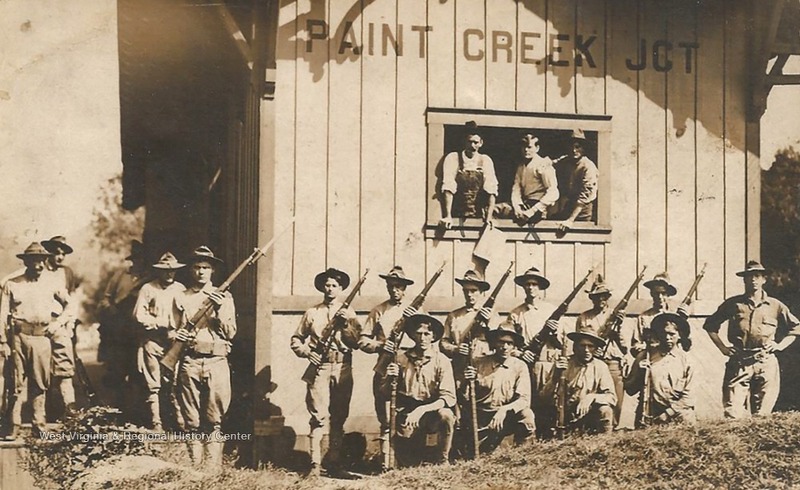
By 1912, coal miners in Paint Creek of Kanawha County, West Virginia had had enough of the industry’s labor system. When the mining contract between Paint Creek miners and the Kanawha Coal Operators Association expired on March 31, the miners rallied for a new contractual agreement. Their demands “included a pay raise of two and one-half cents per ton and union recognition with dues checkoff from miners’ wages” (Ayers & Savage, 2018). Negotiations carried on for days, but the coal operators continuously refused the primary demand of employer recognition of the union. Although “operators of Paint Creek had acquiesced to unionization in 1902,” they sought to maintain ultimate control over the company town and drive out the UMA (Bailey, 2008). Miners began the strike on April 18, 1912.
While miners issued the work stoppage without union authorization, the UMA was “eager to make inroads in the region” and supported the strike by sending labor organizer and orator Mary “Mother” Jones. Meanwhile, the coal operators enlisted armed guards from the Baldwin-Felts Detective Agency to protect company property and intimidate striking miners.
"Throughout that summer of 1912, as skirmishes became more frequent, Mother Jones started appearing at locations along Paint Creek and surrounding areas. On July 4 she told a crowd at the Beckley courthouse that the fight was not between political parties but between capital and labor." —Ayers & Savage, 2018
The resistance spread to the nearby Cabin Creek. With triple the mines and triple the population of Paint Creek, Cabin Creek was even more so under the thumb of its in-state coal barons—and nonunionized. However, taking the Paint Creek strikers’ lead and drawing inspiration from Mother Jones’ rousing call for rebellion, Cabin Creek went from a strictly nonunion area to “a district teeming with men who resolutely committed themselves to the union” (Ayers & Savage, 2018). Thousands of nonunion Cabin Creek miners walked off the job, demanding an end to blacklisting and union recognition. Just like their comrades in Paint Creek, “these men had suffered too long under the ubiquitous paternalism of the coal operators and their guards” (Ayers & Savage, 2018).
The legacy of the Paint Creek–Cabin Creek Strikes is manifold. What was one district’s walkout became a year-long violent rebellion. There was bloodshed on both sides, with an estimated 50 deaths including both striking miners and company men. West Virginia Governor William E. Glasscock declared martial law multiple times. More than 200 striking miners and their allies, including Mother Jones, were arrested, imprisoned, and brought to trial inciting violence (U.S. DOI; Bailey, 2008). The Kern Resolution, sponsored by Democratic Senator John W. Kern in May 1913, called for “a sweeping senatorial investigation” into the strike and the conditions in West Virginian coal mines. In the end, the UMA presented a compromise that won miners important concessions like the rights to select a checkweighman, the 9-hour workday, accountability for miner compensation, and protection from discrimination against union membership.
In West Virginia’s long history of resistance, the Paint Creek–Cabin Creek Strikes were a prelude to increasingly intense clashes between workers and corporations. The Mine Wars later encompassed the Matewan Massacre of 1920 and culminated in the Battle of Blair Mountain of 1921, known for being the largest labor uprising in United States history. While those two conflicts are particularly famous in the story of America’s labor history, the persistent strikes in Paint Creek and Cabin Creek set the stage. As an inciting conflict in the Mine Wars, these strikers were some of the first to band together as a united force and take up armed resistance against West Virginia-stationed coal operators.
The Paint Creek–Cabin Creek Strikes are foundational to West Virginia’s history of resistance. Oppression takes new forms, so resistance must be continuous. In 2026, generations later, we face similar oppression and extraction by Big Tech as miners did by union-busting coal barons. We have plenty to learn from West Virginia’s history, the most prominent lesson being that we are more powerful when we unite and take collective action.
- Title
- Paint Creek Coal Mine Strike
- Description
- Armed coal miners on strike in Paint Creek, Kanawha County, West Virginia. Miners went on strike to demand that the coal operators raise their compensation rate to that of the surrounding area and recognize the union, and the strike quickly became armed hostility between miners and company men. “That spring of 1912, Winchester rifles and ammunition were being brought to and stored at the big house on the hill in Wacomah [...] Seventeen guns and ‘a washtub full of shells’ had to be delivered to the striking miners, all while the house was being closely watched by guards” (Ayers & Savage, 2018).
- Source
- West Virginia History OnView, A&M 3914-ADD
- Title
- Mother Jones Speaking in Montgomery, West Virginia
- Description
-
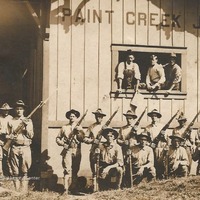
Photograph postcard of labor organizer Mother Jones speaking at a gathering in Montgomery, West Virginia (not far from Paint Creek) in 1912. Her audience included Black and white men, women, and children. Her speech that day stirred inspiration to keep up the rebellion: “I don’t care how much martial law the Governor of West Virginia proclaims. I have had martial law proclaimed where I was more than once, but I didn’t stop fighting… If they proclaim martial law, bury your guns. You can tell [the governor] that if you see him” (Ayers & Savage, 2018).
She traveled throughout the area making appearances and, in the following days, went on to give a similar speech to Cabin Creek miners, turning a strictly nonunion area into a pro-union district ready to follow Paint Creek’s lead by striking in demand of union recognition. - Source
- WVRHC OnView 037994
Rediscovering Activist Publishing
Because the United States saw a surge of political movements in the 1960s–70s, over two hundred printshops emerged to produce all sorts of political-oriented physical media: “the leaflets, posters, placards, pamphlets, buttons, and books these movements are best known for” (Slifer, 2021). Movements demanding attention and action utilized printed ephemera like pamphlets and zines in particular to publish and circulate social issue awareness, political theory, information about organizations/movements, and calls to action.
It was during this era that the Appalachian Movement Press (AMP) emerged out of Huntington, West Virginia as a grassroots, independent publishing label. Operating in the decade between 1969 and 1979, young activists Tom Woodruff, Danie Stewart, Errol Hess, and others ran AMP to print/reprint works about Appalachian history and culture as well as activist literature related to regional labor, coal, and the rights of mountain residents. AMP’s mission was to contribute to the “decolonization of central Appalachia and decolonization of the minds of Appalachians” (Slifer, 2021). Through their publishing, AMP broadcasted the writing and storytelling about Appalachia—by Appalachians for Appalachians.
“We wanted to print pamphlets on famous Appalachians who are ignored in schoolbooks. We wanted to print pamphlets on our Appalachian heritage—on the fight against slavery by mountain people at the time of the Civil War, on the long struggle to gain a greater degree of freedom through organizing unions in the coalfields, and on the general spirit of independence and self-reliance of Appalachians throughout history. We wanted to print pamphlets about how today all our wealth is being taken from us—the wealth we produce, with our resources and our labor, that does not benefit us, but is added to the bank accounts of super-rich corporate owners in Philadelphia, New York, and Pittsburgh.” —Tom Woodruff
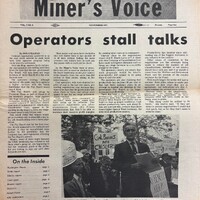
There were also several independent, regional sources of news committed to Appalachia around this time. For one, reporter Thomas N. Bethell’s self-published newsletter Coal Patrol ran from 1970–1973 (with a brief revival starting in 1977) and provided “reports and commentary on coal-related developments in labor, industry and government,” per the description heralded on each issue. The newsletter made a name for itself “twisting thorns in the sides of coal-industry executives” by promoting union groups and reporting hard-hitting news on mine safety, mine disasters, and union corruption. Similarly, independent newspaper The Miners Voice was published by rank-and-file miners in the 1970s as an alternative source of news to the compromised UMW Journal.
Information is political and narratives are rhetorical. Our takeaway from unearthing the work of activist publishing houses like Appalachian Movement Press and grassroots publications like Coal Patrol and The Miners Voice is that there is power in communities controlling their own stories. Unlike national media, these publications paid constant, careful attention to covering West Virginia, Appalachia at large, and regional concerns like coal mining. They were dedicated to rejecting negative stereotypes and replacing them with real, accurate representations. They circulated excavated history and original stories about the place and the people.
In 2026, we are working against a strong current of political tension and monied interests making undemocratic decisions about West Virginia without West Virginians’ input, as demonstrated by the push for data centers. To advocate for better cultural and political representation, we should collectively take back the power of the press. We must support boots-on-the-ground activists and reporters. We must seek out, read, promote, and even help create grassroots, regional publications like that which flourished in Appalachia in the 1970s.
- Title
- Appalachia Movement Press Introductory Pamphlet
- Description
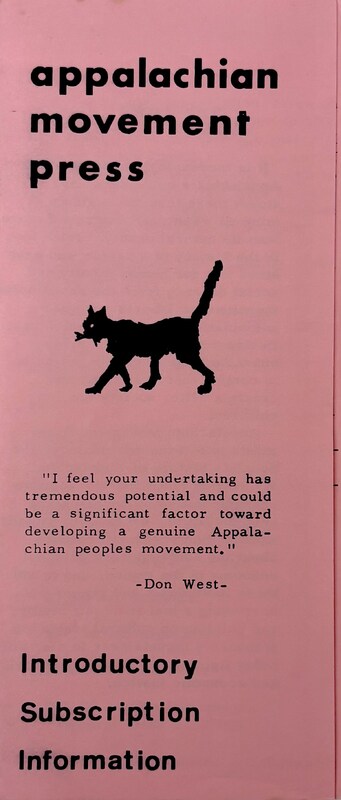
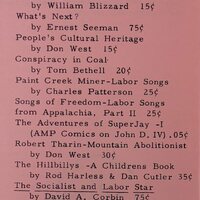
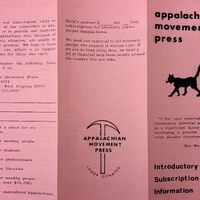
- A pamphlet published by the Appalachian Movement Press (AMP) to introduce the press to new subscribers. The pamphlet includes a statement on the press’s mission to “tell the real history, the people’s history of Appalachia” and to aid those who “are today fighting for social, political, and economic justice”; a list of published pamphlets with corresponding prices; and subscription information. On the back, there are instructions to initiate a subscription by enclosing a check and returning it to AMP’s address, indicating the pamphlet was designed to double function as an envelope.
- Source
- West Virginia and Regional History Center, A&M 4533
- Title
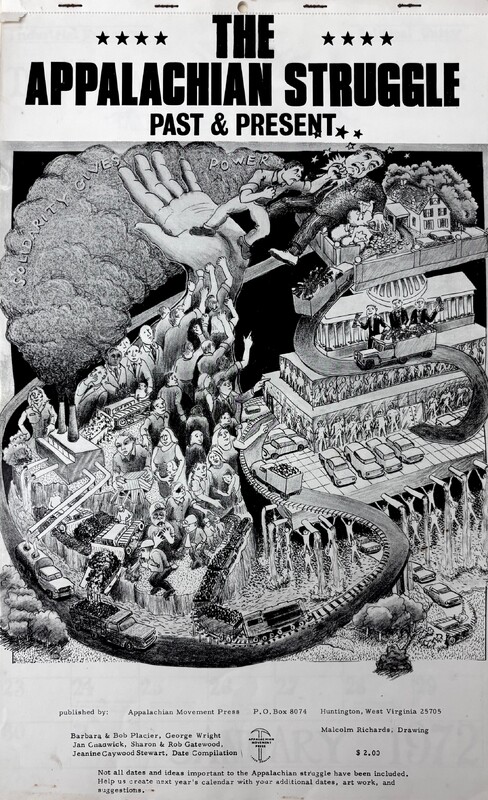
- The Appalachian Struggle: Past and Present
- Description
- A 1972 calendar published by the Appalachian Movement Press (AMP). AMP was an independent activist press based in Huntington, West Virginia, that published works about Appalachian history and culture as well as activist literature related to regional labor, coal, and the rights of mountain residents. This calendar highlights historic dates important to Appalachian struggle and resistance. For example, see the month of January for “W. Va. Miners Strike Protesting Yablonski Slaying” (January 6, 1960), the month of May for “Matewan Massacre, Mingo County, W. Va.” (May 19, 1920), and the month of December for “Monongah #6 Mine Explosion, 361 Killed (December 6, 1907). The calendar’s cover and each month features detailed illustrations by artist Malcolm Richards to illustrate “the concerns of the Appalachian Left” (Slifer, 2021).
- Source
- West Virginia and Regional History Center, A&M 4533
- Media
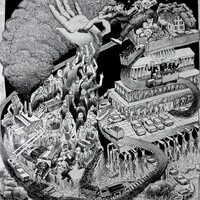 The Appalachian Struggle: Past and Present
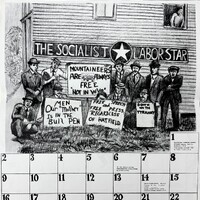 The Appalachian Struggle: Past and Present (January 1972)
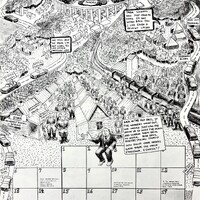 The Appalachian Struggle: Past and Present (February 1972)
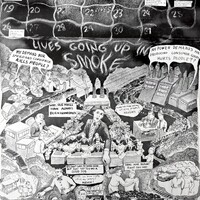 The Appalachian Struggle: Past and Present (March 1972)
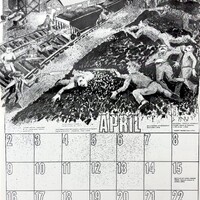 The Appalachian Struggle: Past and Present (April 1972)
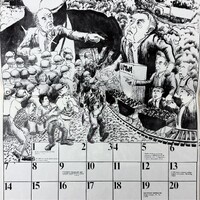 The Appalachian Struggle: Past and Present (May 1972)
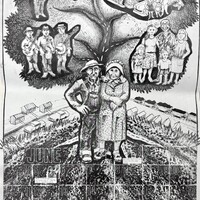 The Appalachian Struggle: Past and Present (June 1972)
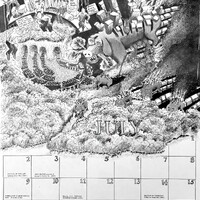 The Appalachian Struggle: Past and Present (July 1972)
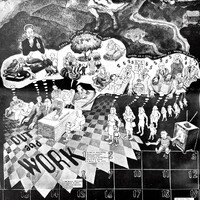 The Appalachian Struggle: Past and Present (August 1972)
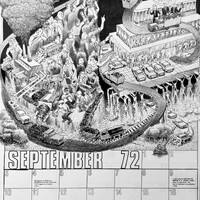 The Appalachian Struggle: Past and Present (September 1972)
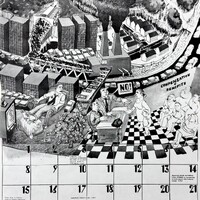 The Appalachian Struggle: Past and Present (October 1972)
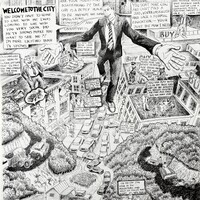 The Appalachian Struggle: Past and Present (November 1972)
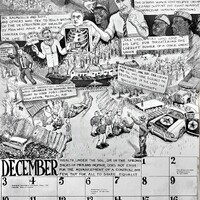 The Appalachian Struggle: Past and Present (December 1972)
- Title
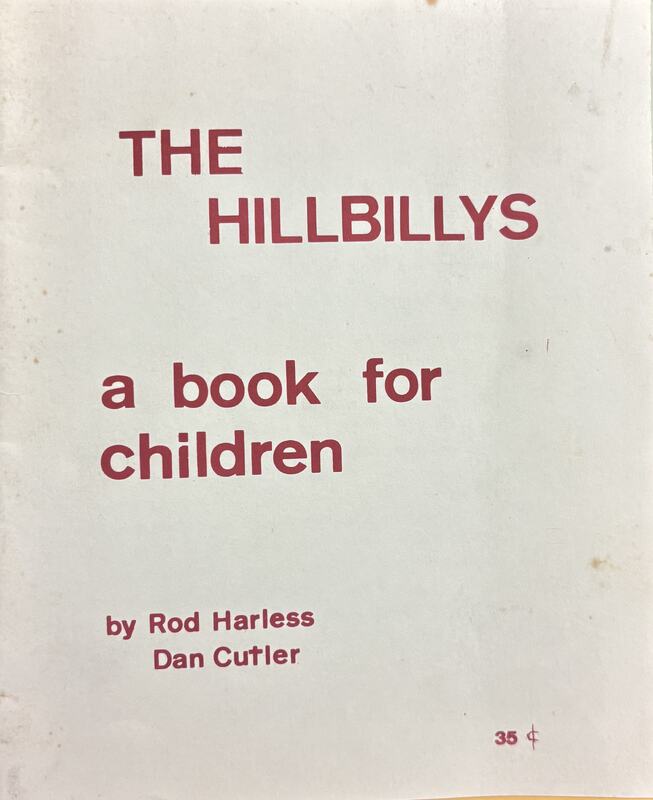
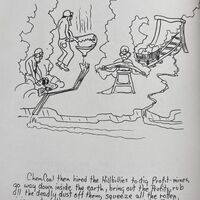
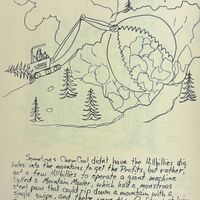
- The Hillbillys: A Book for Children
- Description
- A historical fiction story written by Rod Harless, illustrated by Dan Cutler, and published by the Appalachian Movement Press (AMP). This 38-page story, unlikely to have actually been consumed by children, imagines “an ancient mountain kingdom called Hillbilly Land” in which the Hillbillies are forced to mine by “the Royal Profiteers” and consequently destroy the land, air, and water of their homeland. As a blatant allegory for extraction in West Virginia, the story took “a stark view of prior generations’ inability to counter the corporate takeover of the region’s mineral resources” and called the next generation to take action (Slifer, 2021).
- Source
- West Virginia and Regional History Center, A&M 4533

- Title
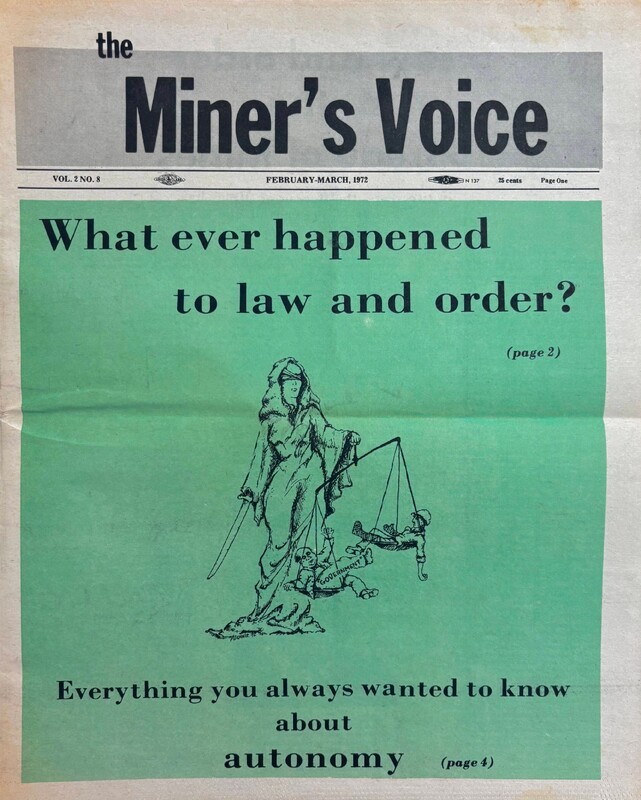
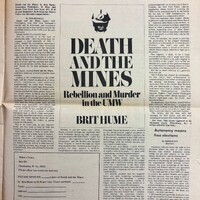
- The Miners Voice
- Description
- Selections from The Miners Voice, an independent newspaper published by rank-and-file miners in the 1970s. The Miners Voice was established as an alternative source of news to the union-controlled UMW Journal, bypassing the media promoted by then-UMW President Tony Boyce, who had become “a compliant tool of the coal industry” and was found to have ordered the murder of campaign opponent Joseph “Jock” Yablonski (Early, 2022). Because of this, they paid particular attention to promoting democratically minded candidates and fair union elections.
- Source
- West Virginia and Regional History Center, A&M 3660
Resisting Data Centers
West Virginia has been targeted time and time again by extractive industries. The first catastrophes were brought on by the coal industry, and now the new extractive industry—Artificial Intelligence and Data Centers—are seeking to profit from the wild and wonderful state.
Groups have already formed in protest for the industrialization that would take place for the construction of Data Centers and the power grids to supply them, including Tucker United, the Mon Valley Green Space Coalition, and the West Virginia Citizen Action Group.
Tucker United
Tucker United is a group formed by Tucker County residents and their allies pushing back against the proposed data center construction in their town. Tucker United describes themselves as “a coalition of Tucker County Residents and allies working to ensure Tucker County remains an economically vibrant, healthy, beautiful place where we can live, work, and play for generations to come.” The group is committed to being an organization that is “non-partisan, horizontal, and focused on the long-term health and economic stability of the community.”
Tucker United has identified their points of concern with the Data Center project:
- Air quality and health impacts (NOX, PM2, inversions)
- Water use, pollution, and treatment (drought, diesel, discharge)
- Noise and light pollution (24/7 power plant and data center, human and wildlife + avian migratory superhighway)
- Public lands and ecologically sensitive areas (such as Dolly Sods)
- Local businesses and outdoors economy (900+ local tourism jobs, ⅓ of county employment)
- Culture and community impacts (grassroots investment, arts, culture)
List of Distances:
- 1.8 from Assisted Living Cortland Acres
- 1.4 miles from Food Bank
- 1.4 miles from Middle School
List of Action:
- Fight back for local rights
- Can use 1800’s legal move : “This is a public nuisance” argument
Legal Info
- WV has rules exempting Data Centers for paying for their own fees
- 30% goes to the data center location, 70% goes to state
What Tucker United has Worked On
Strategy focus: community / civic organizing, legislative, & legal
- Listening to community members
- Raising Awareness of data centers
- Meeting with local officials
- Connecting with other groups in WV & beyond
- Contacting state leaders and regulatory bodies
- Appeal of the air quality permit put out for the data center
- Appeal of the confidential business information (CBI) ruling
The members of Tucker United worked with Harvard and Massachusetts Universities to develop an independent report, which found that an estimated $35 million of annual health damages will result from the power plant.
The construction site of the proposed Data Center is on 500 acres of land, and approximately only 1 mile from a public school.
The mayor of Tucker County was never made aware of the construction project for the data center until local residents questioned him about the project, where he first discovered the construction going on within his town.
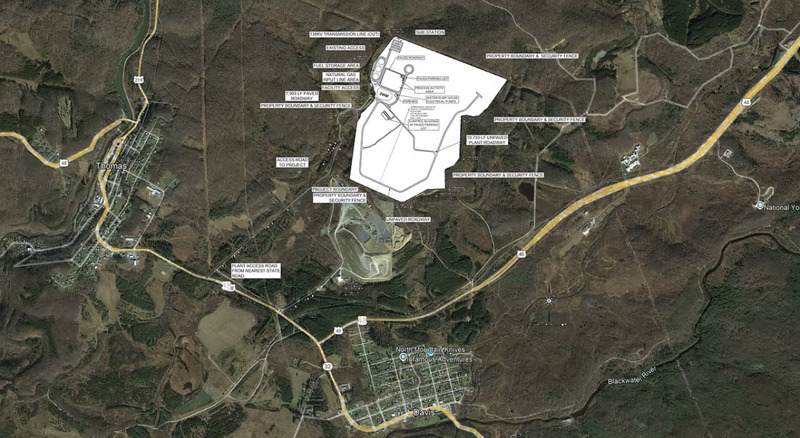
- Title
- Tucker County Microgrid Blueprint
- Description
- Blueprint for the proposed Tucker microgrid powerplant, which would be constructed less than a mile from both the towns of Thomas and Davis in Tucker County, West Virginia.
- Source
- Tucker United
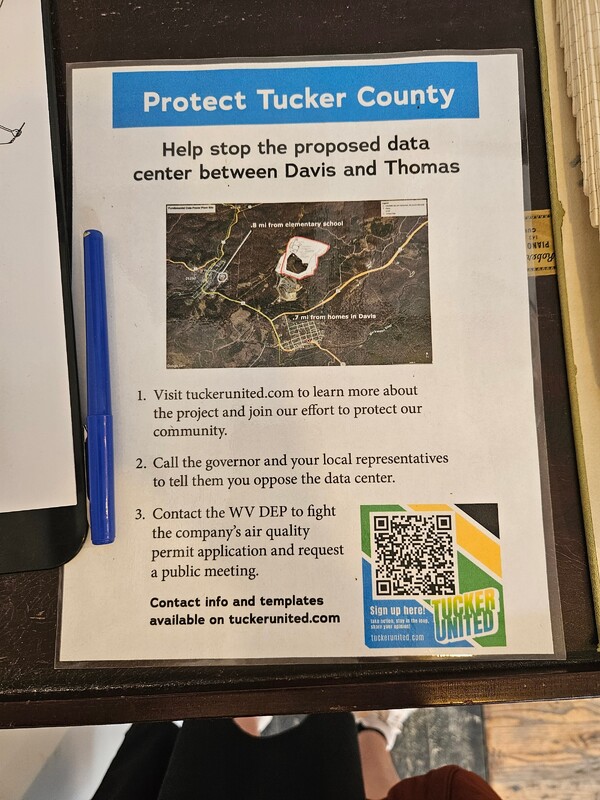
- Title
- "Protect Tucker County"
- Description
- This flyer, spotted in Tucker County, reads "Help stop the proposed data center between Davis and Thomas" and calls on the average citizen to join Tucker United, call the governor and local representatives, and contact the West Virginia Department of Environmental Protection (WVDEP). Tucker United is a grassroots movement that counts on the involvement of as many people as possible to strengthen collective resistance.
- Source
- Dr. Jennifer Sano-Franchini
- Media
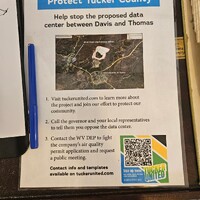 "Protect Tucker County"
Mon Valley Green Space Coalition
The Mon Valley Green Space Coalition is a small community made up of grass-root organizations, non-profits, neighborhood associations, municipal boards, and civic groups. They host several events to educate and inform both residents and tourists alike of the natural beauty of the West Virginia landscape. They hope that by informing the public of the beauty and importance of the ecosystem, they will create more resistance towards the urbanization of the state and its industries.
An annual festival is held on Earth Day—the “Touch the Earth Festival”—where the coalition’s members offer “hikes, wildflower identification walks, and information about the ecological benefits of green space preservation.” The Coalition also oversees the upkeep of trails such as the Morris Loop and Marilla Connector trails, while also providing support for events like forest restoration, removal of invasive species, and ecological restoration events.
The Mon Valley Green Space Coalition hosts meetings over Zoom every second Wednesday of the month, and are always accepting new members. Those interested in joining can contact the group at mvgreenspace.coalition@gmail.com.
West Virginia Citizen Action Group
The West Virginia Citizen Action Group (WV CAG) was established in 1974, advocating “for better public policy, rights of individuals, a clean environment, and a stronger democratic process.” WV CAG believes in affordable healthcare for all, responsible and fair taxation, governmental accountability and transparency, and maintaining a healthy environment, describing themselves as “a leader in the movement to protect our land, air, and water.”
WV CAG has worked to inform the local public—due to national news not covering the potential damages and risks of data centers—of the costs for WV citizens should these buildings be constructed. In the past, WV CAG has also spoken out and held protests against ICE, HB-4013, and the affordability crisis affecting West Virginia. Notably, HB-4013 is the same bill giving large tax credits to big developers, which will cost the state hundreds of millions of dollars every year. If the bill passes, not even the state itself will see the benefits of these developments
- Title
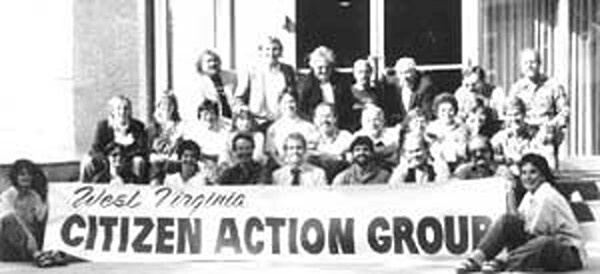
- WV CAG Staff, Circa 1970s
- Description
- WV CAG has advocated for West Virginia since 1974. The original staff of WV CAG included David Grubb, Perry Bryant, Anne Romance, Scott Walker, Clark Sheldon-Whiteside, Marvin Wanetick, Barbara Dungey, Chuck Hampsher, Jim Worthington, Dave Parry, Kent Moreno, Chris Bathurst, Kathy Hamsher, Jeanne Vencill, Dave Wibberg, Lizz Frost, Will Carter, Sylvia Ward, James Spencer, Mary “Ginger” Kessell, Jeff McCroskey, Kathy Josephson, & Cheryl Sheldon-Whiteside.
- Source
- West Virginia Citizen Action Group
- Title
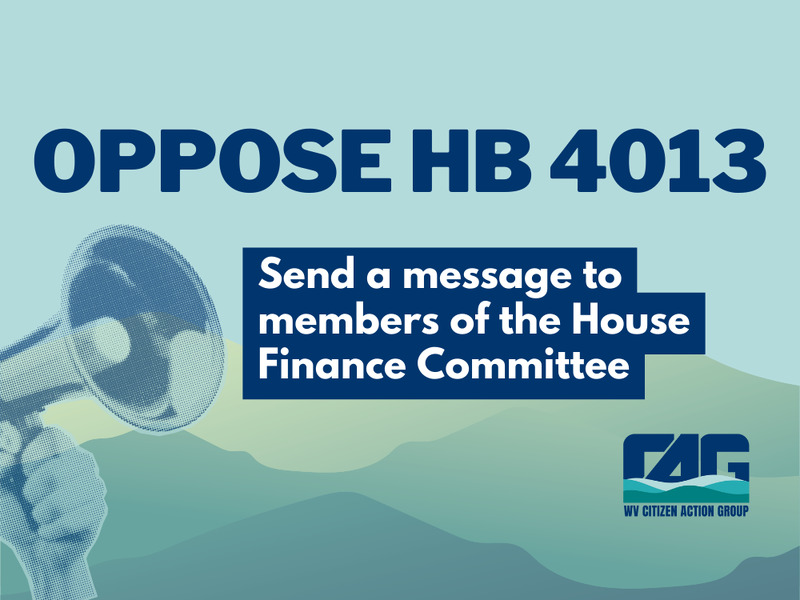
- WV CAG Alert: Opposing HB 4013
- Description
- A promotional image for alerting WV CAG members to oppose and resist HB 4013, the bill that would give large tax credits to large-scale developers like data centers. According to WV CAG, "HB 4013 would give significant tax credits to big developers, costing the state hundreds of millions of dollars annually. Now, not only will the counties not see the tax benefits of these massive developments, but the state will not either." On their website, this page also includes a digital form to contact the House Finance Committee.

Local News Coverage
While many national news stations avoid the coverage of data centers and resistance against them, local stations have reported extensively on the outcry and pushback against the businesses attempting to insert Data Centers.
Just a few of local reports include reports that Data Center’s pollution is connected to lung problems (Millard, 2026), residents traveling all the way to Charleston to protest the proposals of data centers (Rather & DeJarnatt, 2025), and even an interview with a member of Tucker United (Wells, 2025).
While resistance is a new and developing thing, that does not mean it doesn’t have an impact. As these local groups and communities grow, so too will their influence. Their numbers will continue to rise and push back against the industries that have seen West Virginia as something to be exploited rather than something to be cherished.
Bibliography
Asher, A. (2022, December 16). “West Virginia Coal Miners Who Fought Their Bosses Are Getting the Monuments They Deserve.” Jacobin. https://jacobin.com/2022/12/coal-miners-west-virginia-resistance-corporate-domination-blair-mountain-history.
Ayers, G. S., and Savage, L. K. (2018). Never Justice, Never Peace: Mother Jones and the Miner Rebellion at Paint and Cabin Creeks. West Virginia University Press.
Bailey, R. J. (2008). Matewan Before the Massacre: Politics, Coal, and the Roots of Conflict in a West Virginia Mining Community. West Virginia University Press.
Coyne, C. (2025, December 5). Mingo County residents file federal lawsuit against company building power plants, data center in WV. West Virginia Watch. https://westvirginiawatch.com/2025/12/05/mingo-county-residents-file-federal-lawsuit-against-company-building-power-plants-data-center-in-wv/.
Early, S. (2022, December 17). “50 Years Ago, Rank-and-File Reformers Took Over the United Mine Workers of America.” Jacobin. https://jacobin.com/2022/12/uaw-umwa-leadership-election-union-rank-and-file-1970s.
Elder, E. M. (2025). “Company Towns: Single-Industry Dominance and Local Government Capacity.” British Journal Of Political Science, 55. https://doi.org/10.1017/S0007123425101178.
Patterson, J., & McIlmoyle, R. (2026, February 19). Residents share concerns about data centers at WVCAG press conference. WOWK. https://www.wowktv.com/news/west-virginia/residents-share-concerns-about-data-centers-at-wvcag-press-conference.
Porteous, J. D. (1970). “The Nature of the Company Town.” Transactions of the Institute of British Geographers, 51, pp. 127–42. JSTOR, https://doi.org/10.2307/621766.
Rather, J., & DeJarnatt, B. (2025, December 3). Protestors travel to Charleston over proposed Tucker County Data Center. 12WBOY. https://www.wboy.com/news/west-virginia/protestors-travel-to-charleston-over-proposed-tucker-county-data-center/.
Slifer, S. (2021). So Much to Be Angry About: Appalachian Movement Press and Radical DIY Publishing, 1969–1979. West Virginia University Press.
The Mon Valley Green Space Coalition. (2025, November 19). https://www.monvalleygreenspace.org/.
Tony, M. (2026, April 10). Residents fight morrisey-backed data center momentum in WV amid cost, health fears. Charleston Gazette-Mail. https://www.wvgazettemail.com/news/energy_and_environment/residents-fight-morrisey-backed-data-center-momentum-in-wv-amid-cost-health-fears/article_c6a90c00-dc51-4a1a-9804-bc3576150b65.html.
U.S. Department of the Interior. (2024). “Paint Creek and Cabin Creek Strikes.” National Parks Service. https://www.nps.gov/articles/000/paint-creek-and-cabin-creek-strikes.htm.
West Virginia Mine Wars Museum. (2026, April 10). “A Quieter Violence of Company Towns.” West Virginia Mine Wars Museum. https://wvminewars.org/news/2026/4/10/a-quieter-violence-of-company-towns.