History of Mining
"[M]ining carries a huge cost: nothing less than mountains themselves." - Miles O' Brien
Introduction
Coal has been an important part of West Virginia's history and economy since before the state was even created in 1863, making it the second-largest coal producer in the nation. It has shaped not only the state’s economy, but its identity and communities, too. The existence of coal in WV was first reported in the 1700s, but large-scale mining didn't begin until the mid-1800s (West Virginia Office of Energy, 2024).With advances in transportation and industrial demand transformed, it made coal one of the most valuable natural resources in the United States. West Virginia soon emerged as a main supplier of coal, fueling many different kinds of development all across the country. Today, coal deposits are found in all but two of the state's fifty-five counties, showing just how deeply this resource is embedded in the state’s geography and history.
For generations, coal mining has provided jobs, supported the state’s economy, and contributed to the identity of West Virginia. Towns have even developed around the industry, creating tight-knight, small communities whose very lives depend on the success of coal mines. Even now, it is still a current symbol of pride and resilience for many in the state, representing a long history of hard work and sacrifice, most of which is even passed through families.
However, even if coal has played an important role in shaping the state’s growth and identity, it has also brought significant challenges. These same practices that have pushed economic progress have raised serious concerns about their impact on the people and the natural environment. "Coal mining harms land, surface waters, groundwater and even our air. Impacts to the land from mining causes drastic changes in the local area. Damage to plants, animals and humans occurs from the destruction and removal of habitat and environmental contamination. Surface mining completely removes land from its normal uses" (Keating, 2001). Understanding these concerns and impacts is essential, especially when trying to examine how coal mining has affected West Virginia land, water, air, and the people.
Environmental Impacts:
Coal extraction, both surface and underground, has disastrous effects on the environment in West Virginia. In this section, we will explore three major areas of environmental concern: air, water, and land. We highlight the effects of coal on these three major areas of environmental concern, using various case studies to illustrate them.
Water
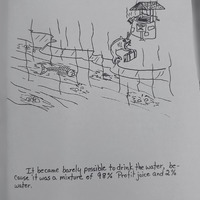
Water quality is severely affected by both underground and surface mining in West Virginia. Due to water run-off and other environmental issues, waterways within West Virginia have been plagued by coal mining dust and sludge, poisoning not only aquatic life but also individuals who use the water for various purposes including need and recreation. The toxic sludge created by water runoff from mining areas is a mix of acid mine drainage that seeps into groundwater and waterways, with acidic rust killing aquatic life in its path (Rojanansakul, 2025). Water quality has been a major concern for many local residents within the state. Wriston states, “Water pollution from surface coal mining has degraded more than 22 percent of streams and rivers in southern West Virginia” (Wriston, 2024). This finding is staggering, especially when it comes to the reach of water pollution. You don't have to be right next to an active coal mine to experience the effects it has on water. Water is fluid and travels, and with that travel come all the toxins mixed within it. So even if you don’t live right next to a coal mine, you may still experience its effects here in West Virginia.
Streams are the first to be attacked by the toxic coal sludge. A local West Virginia resident stated, “I had a stream in my backyard growing up that ran black, contaminated with coal sludge from a nearby coal plant” (O’Brien, 2017). Local residents are faced with the difficulty of living around these contaminated water supplies, as many residents depend on well water, as the city limits do not reach their rural location. With those waterways being poisoned by coal mining acid run off, threatening drinking water for many residents in rural West Virginia (Rojanasakul, 2025). With coal dumps getting washed into major waterways, many chemicals are put into the water, including “arsenic, chromium, lead, lithium, radium, and other heavy metals,” all of which are linked to major health concerns such as cancer and various chronic illnesses and diseases (Santillana, 2025). Water quality poses a major risk for West Virginian’s health and overall well being.
Aquatic life is also extremely at risk due to water pollution in waterways surrounding coal mines, and due to the ways the water moves, gets put into major waterways where local aquatic life is endangered or even killed. Appalachian waterways are known for holding some of the world’s greatest diversity of freshwater animals, including many species that can’t be found anywhere else in the world. The animals are not just fish, but also macro-invertebrates (insects, clams, and crayfish), algae, fungi, bacteria, and unicellular organisms (Chelini, 2021). All of these organisms are required for healthy streams and waterways, and without them, water quickly becomes polluted and dangerous. Coal runoff into water, due to its acidic nature, kills many of the animals and organisms that live or drink the water. Also, salt comes from mine production, mixing with the freshwater aquatic life, which makes the streams incompatible for freshwater aquatic life to remain. Chelini, in their research, states, “They found a clear relationship between the density of mining activities and loss of biodiversity: the more mining there is, the fewer species one finds (2021). Many residents rely on fishing for supplemental food, and without fish to catch, residents go hungry.
Air
Coal mining, both underground and above ground, has detrimental effects on the environment and the individuals living within the communities surrounded by coal extraction and production. One of the major environmental and personal consequences of underground coal mining is the escape of gases from the mine. Methane, a common gas released from underground coal mining, is a colorless, odorless, and highly flammable gas that is commonly found in what many consider “natural gas.” The problem with methane isn’t its odor or its color, it's that it has no color or odor, which is undetectable except in an explosion. For many instances above ground and underground, the explosion is what gives the methane away, but by that point, it’s too late.
When Methane gas builds up underground during mining, it looks for a way to escape, mainly through cracks in the ground or small channels. Bruggers states in regard to methane, “Known as an explosive threat to miners deep underground, methane vapors have also caused fires or blasts in or near homes when it has leaked to the surface.” (Bruggers, 2023) Many of the major coal mine explosions are due to methane leaks, and a spark by machinery igniting the gas into flames. Many coal miners have lost their lives to methane gas explosions including the 1907 Monongah Mining Disaster in West Virginia that claimed over 300 lives. A small explosion followed by a larger explosion due to methane where the ventilation system failed, leaving the air polluted for miners, killing hundreds.
Bruggers asserts that it is not only the coal miners that have to live in fear of an explosion, it’s also the surrounding communities. According to Bruggers, newly constructed homes have methane vents that try to mitigate the risk of a methane explosion, but these vents are also located near homes, raising the risk of disease and air quality issues. Not only are the methane vents an eyesore, but other environmental events also occur, such as land shifts, sinking ground, and changes in surface water.
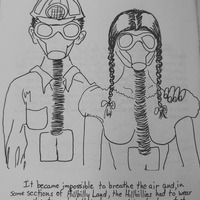
Methane is not the only air pollutant that coal mining creates. Dust is created by the many machines that pulverize coal into what can be sold for profit. Dodson recalls how this dust in created, “The dust seems to consist of pulverized coal and rock blowing directly off the stockpile and trucks, combined with plain dirt that becomes caked onto tires and undercarriages of all those trucks, only to fall off onto the road, and get whipped into the air with every passing vehicle.” (Dodson, 2022) Here we can see that the coal dust reaches way farther than the coal site, with vehicles moving the dust into the air. Dust travels far distances and causes many health problems for not only coal miners, but community members in the area of coal production. This pulverized coal gets into the stream, and stays in the airway for individuals to breathe in. Six air pollutants were found surrounding the coal communities, these include: carbon monoxide, nitrogen dioxide, sulfur dioxide, ozone, lead, and particulate matter. (Dodson) All of these air pollutants combine into one major air pollutant and have detrimental effects on coal miners and even the surrounding population with rising rates of cancer and other respiratory diseases and illnesses. In 2014, researchers showed that toxic dust from mountaintop removal (above-ground mining) promotes the growth of lung cancer in people living nearby. Over time, breathing in particulate matter that is swept up into the air from coal mines can lead to the formation of plaque and inflammation within an individual, increasing their chances of high blood pressure, atherosclerosis, and heart attacks (Appalachian Voices, 2014). It's not just the coal miners getting sick from air pollution; it's their families, too.
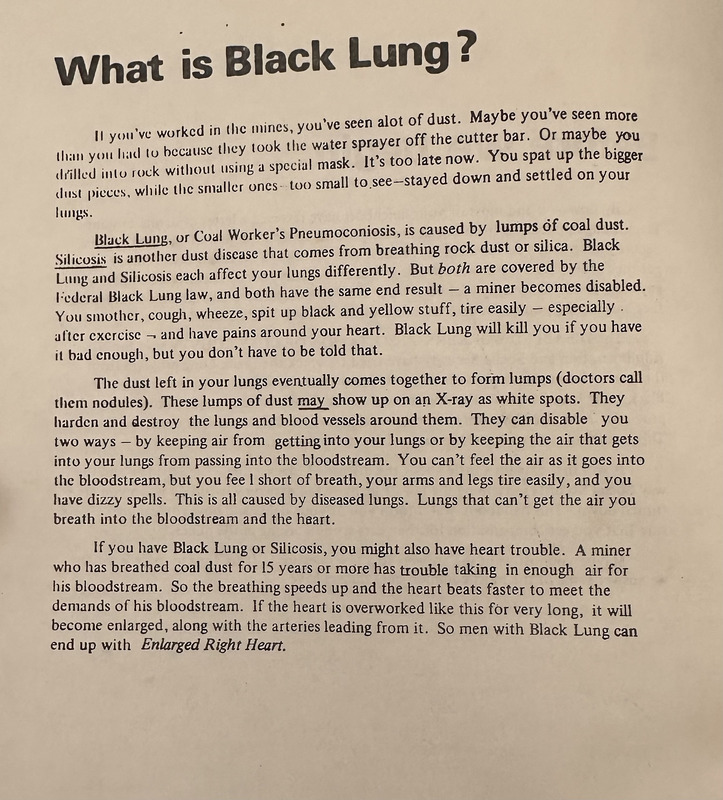
- Title
- "What is Black Lung?"
- Description
- This article is a description of what Black Lung is. It explains how a miner might get it and what side effects could possibly look like.
- Source
- WVRHC A&M
- Media
 Black Lung 2.jpg
Land
Coal mining results in even more severe land damage. Coal mining in West Virginia involves both underground coal extraction and “mountaintop removal” strip mining, in which large sections of land are removed for coal mining extraction. Both coal extraction methods significantly impact the land in West Virginia. While the state is known for its rich wildlife and outdoor adventures, its historical identity has long been tied to these extensive resource extractions. A staggering statistic showcases just how important and abundant coal mining is within the state: “By June 2023, West Virginia has 9,956 underground, 2,540 surface, and 614 quarry miners” (Wriston, 2024). It's obvious just how integral coal mining extraction is to the West Virginia economy, but it's also very apparent that the environmental disasters these practices bring. While coal mining does support the state’s economy, it also severely affects the environment, most notably, the land.
Underground coal mining is the stereotypical image of mining in West Virginia. Underground coal mining is the process of extracting coal from deep seams through tunnels. Individual miners go down into the tunnels and extract the coal. Then the coal is loaded onto conveyors to be sent to the surface. While these tunnels are deep underground, they still have disastrous effects on the land’s surface. Underground mining affects various conditions of the land, from the ground collapsing in on itself to coal sludge seeping into the surrounding communities. Land subsidence is a critical environmental issue caused by underground mining. Since tunnels for underground mining are beneath layers of the earth, land subsidence occurs, damaging everything (houses, vehicles, and large areas of land). Underground mining also creates what's known as “toxic sludge,” which mixes crushed rock, coal, and other minerals to mix with heavy metals and other harmful toxins. This sludge has disastrous effects on the community, with land being destroyed and water being poisoned, making living in a coal mine community even more dangerous.
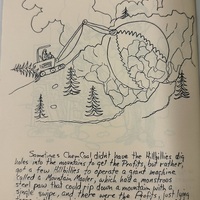
Surface mining, also known as mountaintop removal and/or strip mining, raises additional environmental concerns regarding the land it inhabits. Surface mining consists of removing mountaintops and large sections of land with the goal of extracting coal” (Wriston, 2024). David Pacchioli, in their research, states, “Mountaintop removal mining is a particularly destructive form of surface mining which involves literally blasting away the top of mountains to get at the coal reserves below, which has become a dominant land-use issue in central Appalachia, impacting vast areas of West Virginia” (Pacchioli, 2011). It’s important to note the destructive nature of surface mining. For a state that is known for its vast hills and mountains, West Virginia’s economy, which is based on coal, makes it hard for both to exist at the same time. The real cost of surface mining isn’t just removing dirt; it’s destroying the very thing that makes West Virginia the state it is, our beautiful hills and mountains. Miles O’Brien asserts just how much the practice of surface mining has taken away, “In the hills of West Virginia, surface mining carries a huge cost, nothing less than the mountains themselves, the icons of this beautiful state” (O’Brien, 2017). Surface mining is taking away what makes West Virginia so special.
Surface mining has even more disastrous effects than just destroying hills and mountaintops; it also affects the individuals within the community. Clay Mullins, a former underground coal miner who lives next to a surface mining site, endures the sounds of daily explosions and the destruction of the wooded areas where he once hunted and fished (O’Brien, 2017). Surface mining acid runoff severely affects the wildlife in the surrounding coal communities. With toxic sludge (coal, dirt, and other chemicals) seeping into the earth through water, wildlife and aquatic life are severely destroyed. Without clean and chemical-free environments, animals cannot live. This also affects the individuals within the community who rely on hunting or fishing for supplemental food or income. West Virginia is known for being an impoverished state (Pacchioli, 2011). In an impoverished community, many individuals rely on hunting to meet their supplemental needs. Without wildlife to hunt, community members are affected. Also, for mountaintop removal, they must remove all flora in the area, including trees, vegetation, and other plants. With depleted wildlife environments, animals do not survive, leaving nothing but a blank space for coal mining. Based on research, 10% of the land in central Appalachia is now either active or reclaimed surface mines (O’Brien, 2017). While the underground crumbles, surface mining finishes the job with the extraction of our environment, the same environment that makes West Virginia the state it is.
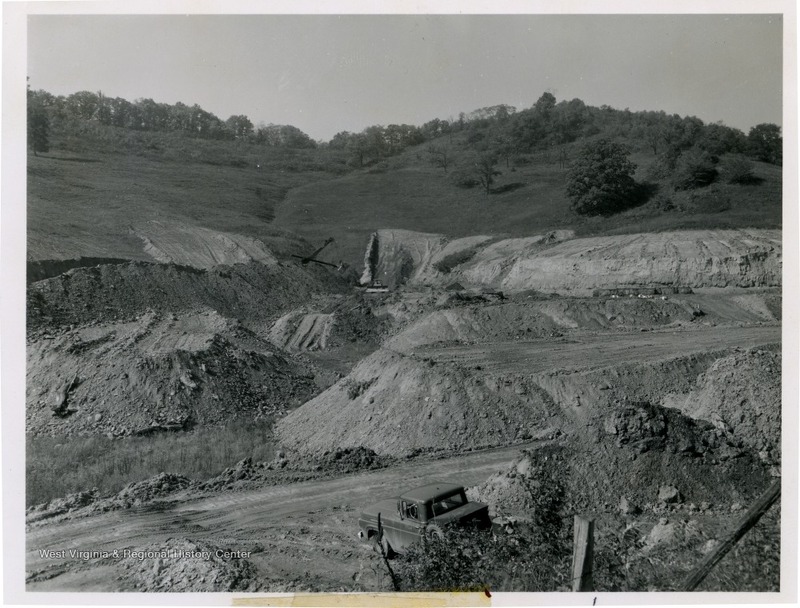
- Title
- C and P Coal Company Strip Mine
- Description
- Agricultural land being stripped by the C and P Coal Company in Taylor County. After mining, this land will be leveled and sloped for drainage, then restored to productive farm cover.
- Source
- WVRHC A&M 5235
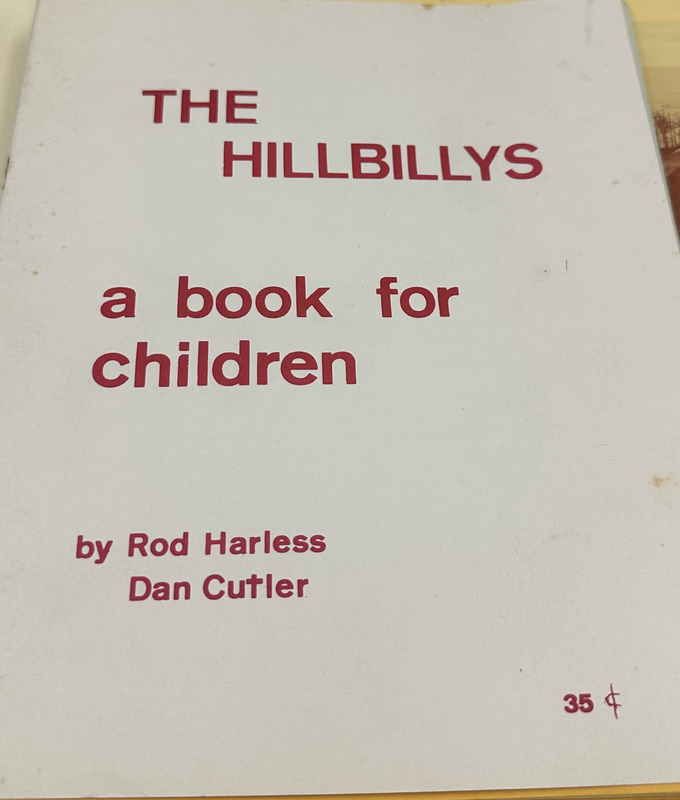
- Title
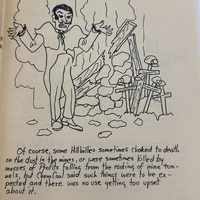
- The Hillbillys: A Book for Children
- Description
- A historical fiction story written by Rod Harless, illustrated by Dan Cutler, and published by the Appalachian Movement Press. While this is a 38-page story, this collection has attached images specific to land, water, and air quality.
- Source
- WVRHC A&M 4533, B1

Case Studies:
In addition to what has been discussed, West Virginia has a long history of mining disasters and explosions. Below we have provided two different examples that are meant to work as a case study to identify patterns of harm within the coal industry.
If this kind of research and history interests you, here is a list of more gas explosions: Monongah 6 & 8 (1907), Eccles No. 5 & 6 (1914), and a more recent one Upper Big Branch (2010). You can also find a comprehensive list of mine disasters and their causes at the West Virginia Office of Miner’s Health, Safety and Training.
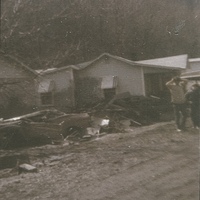
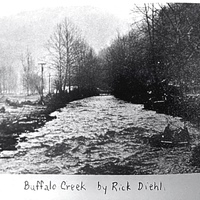
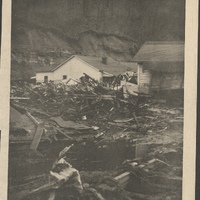
Buffalo Creek Flood
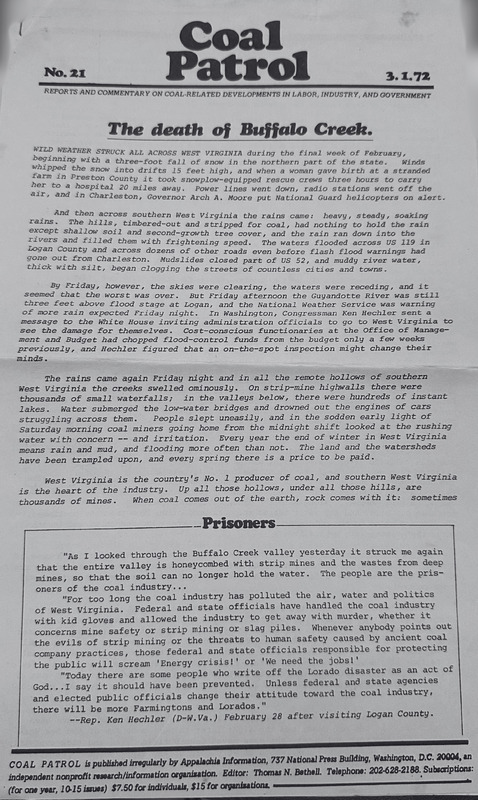
Buffalo Creek Valley is a series of communities built on a coal mining industry along the banks of a small stream in Logan County, West Virginia. By the 1900s, the Buffalo Mining Company, a child corporation of the Pittston Coal Company, owned all the mines and mining operations along Buffalo Creek. At first, they had dams along the creek that are called coal reduce dams or coal slurry impoundments, which were created by using the coal mining waste and sludge that came off of good coal as it was washed, which ultimately left the dam with the possibility of slipping. After a coal refuse bank in Aberfan, Wales, slipped, killing 144 people, The U.S. Bureau of Mines inspected 38 of these waste dams in the state of WV and concluded that the dam could be breached and would cause damage.
This led to the creation of dams numbers 1, 2, and 3; all of which were also coal reduce dams. Buffalo Creek's Dam No. 3, specifically, had a long history of problems after its creation. So much that the residences of Buffalo Creek were worried about the potential failure of it every time it rained. In 1971, an inspection of the dam stated that it was deficient because of its lack of emergency spillway or overflow systems. In late February of 1972, just three days before the disaster, the mining company knew their dams were not considered safe, because an overflow pipe was blocked in Dam No. 3. When the water began to rise overnight on the 26th of February, the company failed to alert officials and residences, reassuring “the dam will hold” (Rhee, 2015).
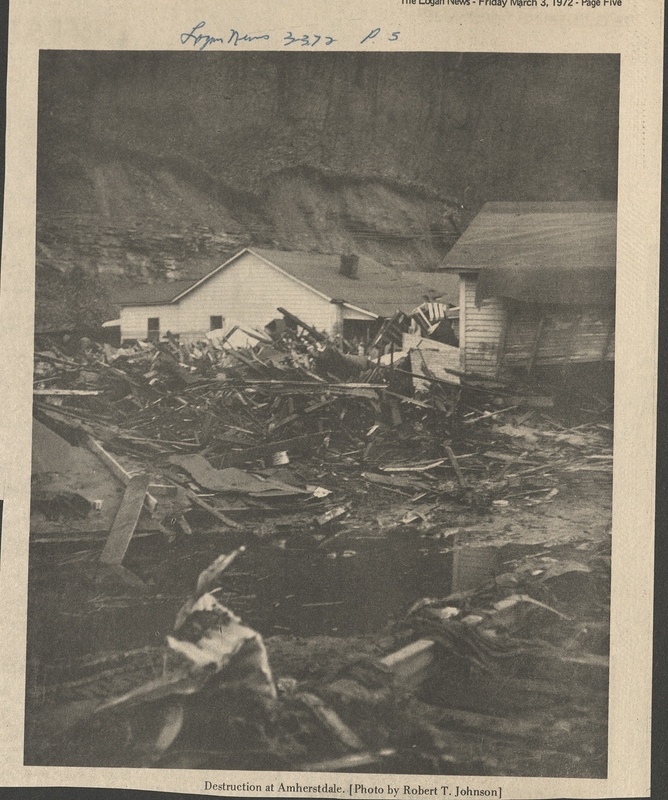
It was 8 o’clock in the morning when Dam No. 3 failed, sending millions of gallons of water and coal slurry down Buffalo Creek. Following suit, both Dam No. 1 and No. 2 collapsed. Over the next hours, the communities along the creek were devastated, leaving 118 killed, several never accounted for after the disaster, 1,119 physically injured. There were 4,000 people left homeless, 507 homes destroyed, 273 homes left with major damage, and 44 mobile homes completely destroyed. Ten bridges were destroyed, and hundreds of miles of roads and highways, leaving the valley with damage it would take years to recover from (Coon, 2022).
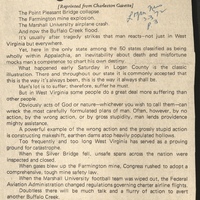
- Title
- “The Death of Buffalo Creek”
- Description
- This article was released after the Buffalo Creek Mine Disaster. The work highlights the environmental conditions that led to the dam breaking. Due to heavy rain, rising creek beds, and waterfalls created at strip-mining sites, the precautions in place quickly gave out, leaving towns and people under water with nowhere to go. With it now being considered one of the most deadly mine-related disasters to occur within the United States, 125 individuals died, with over 1,000 injured. With dam no.3 failing and people losing their lives, this is a reminder of how coal mining can alter the environment, leading to harm or even death. This disaster led to the Dam Control Act of 1973, forcing stricter safety regulations. The Coal Patrol article gives an in-depth narrative of the tragedy caused by underground and surface mining.
- Source
- WVRHC A&M 4533, B1 F3
- Title
- Buffalo Creek Disaster
- Description
- A collection of photos and newspaper clippings of the disaster.
- Source
- WVRHC A&M
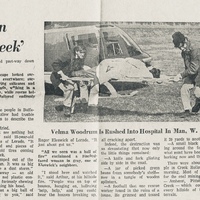
Christopher No. 3 Mine Tragedy
On May 12th, 1942 at 2:25 PM, the Christopher No. 3 mine in Osage, which is a small community in Monongalia county, West Virginia exploded and killed 56 miners. It was caused by an electric arc from machinery setting off an explosion of methane that has accumulated in a dusty area of the mine that coursed through three sections. Due to a malfunction in ventilation in the mine, methane gas built up without a notice, since methane gas is odorless and colorless. When a miner unintentionally created a spark with machinery, that small spark sent the explosion ablaze, leaving many men killed on impact or the damage to their lungs to smoke inhalation. At the time of the explosion 130 miners were on duty and 56 miners lost their lives. Rescue teams came from all over West Virginia to help the men who were trapped in the mine due to the drastic nature of the explosion.
The blast happened three miles underground and it took almost an entire month after the explosion to find the last few bodies. Families were left waiting and wondering if their family members were to be discovered under the rubble, holding out hope that their loved one may still be alive. Over the years, 18 other men were killed in individual accidents in this same mine; making it one of the largest coal mine disasters in history (Owen, 2021).
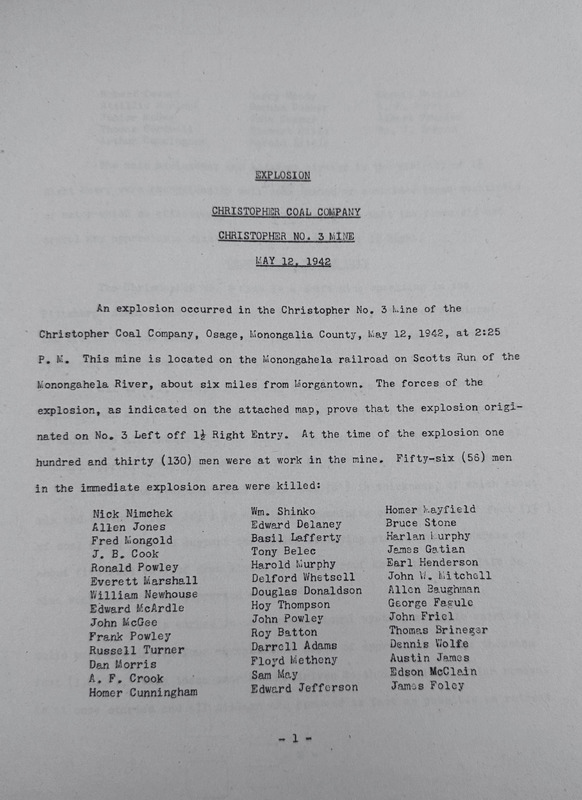
- Title
- Christopher Coal Company NO. 3 Mine Report
- Description
- In the afternoon of May 12, 1942, an explosion occurred at the Christopher Coal Company Mine (mine number 3), located in Monongalia County. Located near the Monongahela River, just six miles from what is now known as Morgantown, West Virginia. When the explosion occurred, 130 men were inside the mine at work. In the split second of the explosion, 56 men were instantly killed on impact. When the explosion occurred, a fire occurred beyond the direct impact. The cause of the explosion is said to have been triggered when a worker accidentally left a ventilation door open, permitting methane to accumulate. When a spark from machinery occurred, the explosion ignited, instantly killing 56 men within the mine. This explosion is one of the first major mine explosions in the state, and with this coal company.
- Source
- WVRHC A&M 4203, B1, F4
Conclusion
The long history of coal mining in West Virginia reveals a long pattern of extraction naked by water contamination, deforestation, and long lasting ecological destruction. These impacts are not accidental, but are inherent to an industry that was built on removing natural resources at a large scale, often leaving behind altered and unusable landscapes and strained ecosystems. Understanding this long history helps frame extraction not just as a historical thing, but as an ongoing relationship between industry and the environment. Now that we’ve examined the extractive history of mining in West Virginia, we can now turn to the more current form of resource demand; data centers. We can now consider and examine their fast growing footprint parallels between earlier industries and how they strain the environments that sustain them.
Bibliography
Appalachian Voices. (2014). Appalachian Voices: Human Health Impacts. https://appvoices.org/end-mountaintop-removal/mtr101/health-impacts/
Bruggers, James. (July 02, 2023). Little Publicized but Treacherous Methane from Coal Mines Upends the Lives of West Virginia Families. https://mountainstatespotlight.org/2023/07/02/coal-methane-arch-west-virginia-families/
Chelini, Marie Claire. (September 01, 2021). Mountaintop Mining Causes 40 Percent Loss of Aquatic Biodiversity. https://today.duke.edu/2021/09/mountaintop-mining-causes-40-percent-loss-aquatic-biodiversity
Coon , C. (February, 2022). The Buffalo Creek Disaster. The Buffalo Creek Disaster: 50 Years From Flooding. https://storymaps.arcgis.com/stories/a2f1ea2c8ba9494b821d76458b15b41c
Dodson, Willie. (March 22, 2022). A Cloud of Coal Mine Dust Over a West Virginia Community Points to Regulatory Shortcomings. https://appvoices.org/2022/03/22/a-cloud-of-coal-mine-dust-over-a-west-virginia-community-points-to-regulatory-blindspots/
Keating, M., et all. (June, 2001). "Cradle to grave: The Environmental Impacts from Coal." https://cdn.catf.us/wp-content/uploads/2019/10/21093511/Cradle_to_Grave-300.pdf
O’Brien, Miles. (May 03, 2017). How Mountaintop Mining Affects Life and Landscape in West Virginia. https://www.pbs.org/newshour/show/mountaintop-mining-affects-life-landscape-west-virginia
Owen, B. (July, 2021). Christopher No. 3 Mine Tragedy. The Historical Marker Database. https://www.hmdb.org/m.asp?m=176272
Pacchioli, David. (February 14, 2011). Assessing the Human Impacts of Mountaintop Removal Mining. https://www.psu.edu/news/research/story/assessing-human-impacts-mountaintop-removal-mining
Rhee, W. (December, 2015). Buffalo Creek Timeline. College of Law . https://www.law.wvu.edu/buffalo-creek-symposium/buffalo-creek-timeline
Rojanasakul, Mira. (June 25, 2025). How West Virginia is Pulling Pollution, and Rare Earths, Out of Its Streams. https://wvwri.wvu.edu/news/2025/07/01/how-west-virginia-is-pulling-pollution-and-rare-earths-out-of-its-streams
Santillana, Christine. (September 03, 2025). Toxic Coal Ash in West Virginia: Addressing Coal Plants’ Hazardous Legacy. https://earthjustice.org/feature/coal-ash-states/west-virginia
Wriston, Jacob. (April 16, 2024). The Impacts of Coal Mining on Southern West Virginia. https://storymaps.arcgis.com/stories/5707db269fdd43399a34490f77d1e1db