Legislation
"After a mountain is stripped, blasted, displaced and “reclaimed,” what truly remains?” —L. Renee
Resistance can lead to legislation, though legislation itself is often said to be slow-moving and difficult. The policymakers we rely on may advocate for their constituents, but more often than not, it's on the people within affected communities to advocate for themselves. Grassroots movements and efforts are common, especially when cries for help fall on deaf ears. The change that we see take place can be slow, but all it takes is a desire to make a difference within the community and a community with a desire for change.
Clean Water Act of 1972
“The Clean Water Act (CWA) establishes the basic structure for regulating discharges of pollutants into the waters of the United States and regulating quality standards for surface waters. The basis of the CWA was enacted in 1948 and was called the Federal Water Pollution Control Act, but the Act was significantly reorganized and expanded in 1972. ‘Clean Water Act’ became the Act's common name with amendments in 1972." —USEPA, 2026
While the CWA has been tantamount to the safety of water quality for those across the United States, many citizens fell and still fall through the cracks. Particularly those residing in West Virginia and throughout Appalachia. Coal mining is seen as a necessity for many in Appalachia and throughout the country and with West Virginia providing 14% of the nation's coal supply (USEIA. 2023), mining has been and continues to be a primary contributor to the state’s economy. However, while coal remains integral to many Appalachians’ means of survival, its detriments and drawbacks are difficult to ignore. From health concerns to dangerous work practices risking the lives of coal miners and those near mining sites, tens of hundreds of West Virginians have felt the negative effects of extraction even despite its apparent benefits.
In January of this year, a proposal for the Coalfield Clean Water Act was submitted as many West Virginians closest to the coal mines have suffered from lack of access to clean water. West Virginia Highlands Conservancy interviewed several West Virginians about their water, Reverend Caitlin Ware, co-director of From Below: Rising Together for Coalfield Justice said, “Some people were told they should not bathe in it,” Ware said. “But what else are they going to do? It’s not like you can bathe in the creeks" (Howes, 2026). While the CWA exists, there are no state specific water regulations in West Virginia, resulting in decades without clean water access.
Surface Mining & Reclamation Act of 1977
Coal mining may be an integral part of US energy infrastructure, but its effects on people and especially the surrounding government are often made to appear negligible. This is not the case.
Coal mining is carried out in several different methods. Whether it be a surface mine, a contour mine, or mountain top mining, it affects the surrounding area in ways that can be irreversible and environmentally harmful. Due to the great effect that any mining method poses to the surrounding area, a federal act was passed in 1977 to ensure the sanctity and safety of coal rich areas. However, this act’s enforcement was allowed to be determined by state decision (EPA, 2026).
The act itself created two methods of enforcement, split between title IV and V. Title IV is primarily concerned with reclaiming abandoned land mines and restoring the environment, which in theory helps those who live nearby abandoned mines. Act V is concerned with regulation and protecting the environment. The Office of Surface Mining Reclamation and Enforcement is meant to regulate any coal mining operations and provides “oversight of the State and Tribal regulatory programs that have obtained primacy” (OSMRE).
While these regulations and regulatory enforcement agencies have been established for some time, this doesn’t mean that their efforts are always successful. Such is the case for school children in the early 2000s at March Fork Elementary school.
Massey Energy V. Marsh Fork Elementary
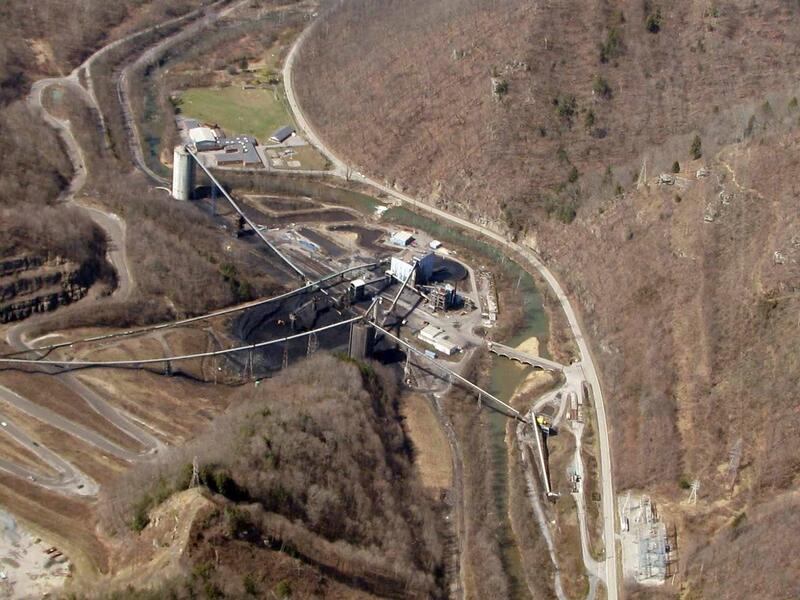
Marsh Fork Elementary School, located in Sundial, West Virginia, was just like any other primary school. Young children played and learned, like any others. What wasn’t quite normal were their neighbors. Just 250ft away from hundreds of school aged children stood Massey Energy’s Coal processing plant. And over time, the proximity began to show.
Living on Earth conducted an interview in the spring of 2007 with community members to discuss the dangers of having the processing plant as well as a lake of coal slurry that undoubtedly would drown the school if it were to break. In February of 1972, over 100 million gallons worth of coal waste broke through a dam in Logan county and into Buffalo creek. This disaster killed 127 people and injured thousands of others. “Out of the Buffalo Creek disaster came improved standards and oversight of what are known as coal “slurry impoundments.” But safety and environmental concerns persist to this day. There are still roughly 150 of these toxic lagoons in the region, many of them associated with what are known as mountaintop removal coal mines (Young, 2007).”
While the trouble Ed Wiley had worried about never came to fruition, another disaster struck the people of Marsh Fork.
On April 5th of 2010, an explosion in the Upper Big Branch mine killed 29 miners, marking the worst mine disaster in 40 years. Massey Energy claimed that the explosion was an unavoidable natural build up of gas, but the Mine Safety and Health Administration (MSHA) deemed the fault with Massey and their long track record of poor safety practices.
“MSHA’s year long investigation concluded that a small ignition at the mine’s longwall shear, the massive machine that cuts coal and rock, triggered a huge explosion when excess coal dust caught fire. MSHA found safety problems all along the chain of events. Spray nozzles meant to cool the machinery and control dust were clogged or missing altogether. Dust control was inadequate. The air ventilation system showed “chronic problems” in the months before the explosion. A company safety examiner’s gas monitor hadn’t even been turned on for two weeks before the explosion.
And while the company took note of problems in its maintenance logs, the official set of books did not reflect those hazards" (Young, 2018).
- Title
- Marsh Fork Elementary School
- Description
- Photograph of Marsh Fork Elementary School in Sundial, West Virginia, taken in 2009. The school sits in the top left corner of the image. From the white silo on, everything in view is the Massey Energy Coal Processing Plant.
- Source
- Vivian Stockman, vivian@ohvec.org
Current Day Marsh Fork Elementary
The Upper Big Branch mine disaster made history, not only because of the sheer scale and severity of the incident, but because of its results. Massey Energy, owner of the processing plant that loomed over Marsh Fork Elementary and the Upper Big Branch mine, was later sold and both sites were closed. It took endless amounts of activism on Ed Wiley and many others’ parts to begin the Pennies for Promises initiative when Senator Joe Manchin and other elected officials failed to listen to pleas for a safer school for the children to learn out of.
“Dubbed 'Pennies of Promise,' the campaign’s aim was to generate public support and to draw attention to the issues and impacts of mountaintop removal by collecting pennies. These pennies would be given to the state to aid the funding effort. Their efforts captured the imagination of elementary school kids as far away as New York who collected and sent pennies for a new Marsh Fork Elementary School. From the Associated Press: 'Coal River Valley residents launched a fundraising effort to build a new school in Raleigh County by presenting about 90 pounds of pennies and a piece of their mind to Gov. Joe Manchin on Tuesday. The residents say Manchin and his administration have ignored their allegations that Marsh Fork Elementary has a dangerous amount of coal dust in classrooms and that its location below a coal waste dam imperils students'" —Keating, 2013
These efforts grew nationwide attention, garnering letters written by school children all the way in California, advocating for change and a safer school environment for the children of Marsh Fork to learn in.
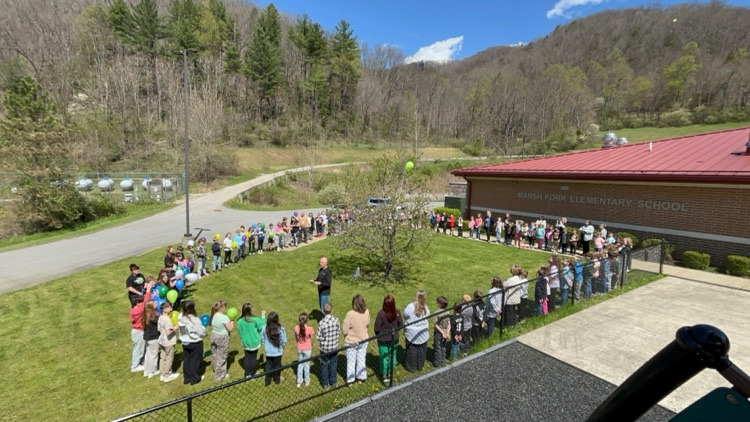
Marsh Fork Elementary persists, having been relocated, rebuilt, and opened in 2013. And despite their revitalized school, they still remember what it took to get to where they are now.
Throughout West Virginia, the presence of coal mining is integral to Appalachian culture and many livelihoods. While its benefits are apparent, it exists as a necessary evil due to the wounds it inflicts on Appalachians day in and day out. The extraction of coal in West Virginia is likely to persist in the years to come, but so long as there are consistent efforts by local activists to ensure the safety of nearby communities, the smudge that coal leaves may lessen with time.
- Title
- Upper Big Branch Mine Disaster Memorial
- Description
- Photograph of Marsh Fork Elementary School's annual memorial in honor of the 29 miners who lost their lives in the Upper Big Branch Mine Disaster.
- Source
- Marsh Fork Elementary, 2026, https://www.boe.rale.k12.wv.us/o/marf/live-feed
West Virginia Highlands Conservancy V. South Fork Coal Company
If you happen to live in Morgantown, West Virginia, you’ll often hear people refer to the giant river that runs through the town as the “Mon.” While they may shorten the name, the importance of the Monongalia River and Forest is much greater than it seems. Nearly a million Americans' water is sourced from the Monongalia River. This means of course, that when connecting bodies of water are infected with coal sludge, dust and heavy metals, those waters become contaminated as well. This affects not only the Americans who live near and source water from the Mon but the litany of ecosystems and organisms that survive in and off of those waters.
One of those organisms that lives within the Mon is the Candy Darter, a small freshwater fish that was declared an endangered species by the US Fish & Wildlife Services in 2018 (ABRA, 2026). Its home in the South Fork Cherry River was designated as an endangered habitat, due to noncompliant practices by coal companies. South Fork Coal Company in specific.
The South Fork Coal Company (SFCC) is one of many companies that has engaged in illicit practices that endanger the surrounding ecosystem where they mine their coal. The Rocky Run surface mine was dependent on access and coal roads to carry out their operations. The action of hauling coal throughout the Monongahela National Forest was adamantly opposed and challenged by conservation groups such as the West Virginia Highlands Conservancy (WVHC), an organization focused on the Highlands region of West Virginia.
WVHC, Center for Biological Diversity, Appalachian Voices, Greenbrier River Watershed Association, Kanawha Forest Coalition, and the Sierra Club filed a lawsuit against the United States Forest Services in 2024 for their failure to enforce and comply with the National Environmental Policy Act (Conservation Groups v. Forest Service, 2024). This particular suit hinged on the Candy Darter and its habitat, the Cherry River Watershed, being declared endangered. Later that year, WVHC and Appalachian Voices would file a lawsuit against the South Fork Coal Company for “...[Discharging] and [continuing] to discharge pollutants into waters of the United States in persistent violation of Section 301 of the Clean Water Act, 33 U.S.C. § 1311, and of the conditions and limitations of three West Virginia/National Pollution Discharge Elimination System (“WV/NPDES”) Permits issued to South Fork by the State of West Virginia pursuant to Section 402 of the Clean Water Act (West Virginia Highlands Conservancy and Appalachia Voices v. South Fork Coal Company, LLC, 2024)." It would be revealed during this case that SFCC had 82 self reported CWA violations since 2019 with heavy metal water levels being 900% above the legal limit.
Just two months after the suit, South Fork Coal Company would go bankrupt in February of 2025. While it took litigation and the gathering of multiple conservationist groups to file suits and cause the ultimate bankruptcy of an unsavory business entity, these conservation groups consist of locals advocating for their homes.
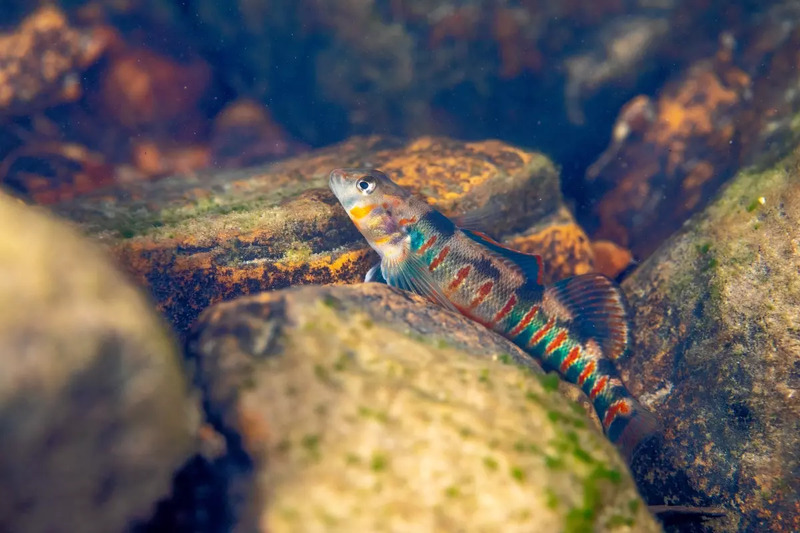
- Title
- Candy Darter
- Description
- Photograph of the Candy Darter, a small freshwater fish that was declared an endangered species by the US Fish & Wildlife Services in 2018 (ABRA, 2026)
- Source
- Ryan Hagerty, US Fish and Wildlife Services, 2022
- Media
 Candy Darter
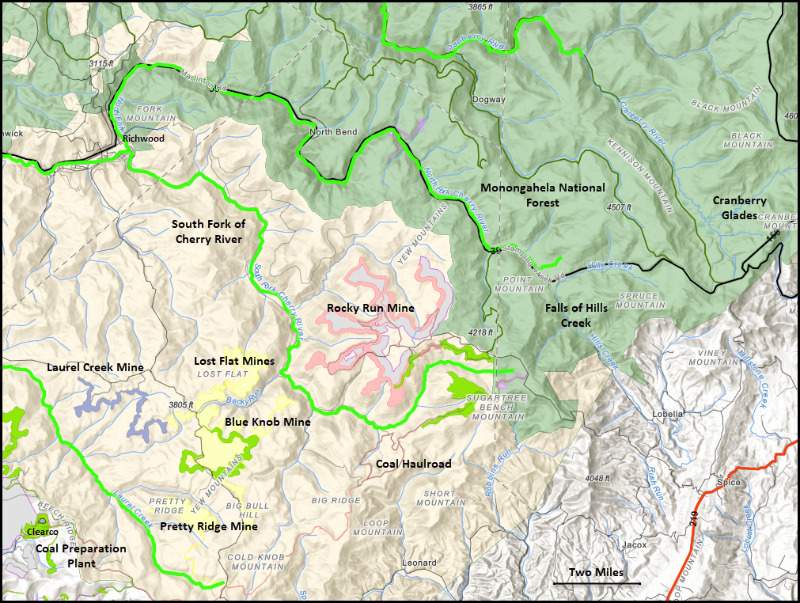
- Title
- Mon Forest and South Fork of Cherry River
- Description
-
Map of the Mon Forest and South Fork of Cherry River. Surface coal mining is expanding in the mostly forested, high-elevation watershed of the South Fork of the Cherry River. This remote high-mountain area supports the candy darter, native brook trout, and remnant red spruce forest.
This map shows permitted coal operations in the South Fork of Cherry River watershed and adjacent areas within the proclamation boundary of the Monongahela National Forest. Critical habitat for the candy darter is highlighted in bright green. - Source
-
Coal Mining and Candy Darter Habitat, https://conservation-abra.hub.arcgis.com/pages/south-fork-cherry
Community resistance comes in many forms. It may look like Ed Wiley’s walking campaign or the Pennies for Promises initiative. It could look like conservation efforts or filing legal complaints against companies who threaten the safety of communities. Legal battles may be tireless and require persistence, but communities can make the legal system work for them as it was intended to do. No matter which form it manifests in, community resistance isn’t possible without people being willing to fight for what they believe and working with their fellow community members.
Bibliography
Center For Biological Diversity, Appalachian Voices, Greenbrier River Watershed Association, Kanawha Forest Coalition, Sierra Club, And West Virginia Highlands Conservancy V. United States Forest Service, Randy Moore, In His Official Capacity As Chief Of The Forest Service, & Jason Hattersley His Official Capacity As Gauley District Ranger Of The Forest Service (2024). Complaint For Declaratory And Injunctive Relief. United States District Court For The District Of Columbia.
Coal Mining. (n.d.). Kentucky Geological Survey. https://www.uky.edu/KGS/coal/coal-mining.php
Coal Mining and Candy Darter Habitat. (n.d.). Allegheny-Blue Ridge Alliance Conservation Hub. https://conservation-abra.hub.arcgis.com/pages/south-fork-cherry
Hagerty, R. (2022, May 11). Candy Darter Photo. U.S. Fish & Wildlife Service. https://www.fws.gov/media/candy-darter-3
Highlands Conservancy, W. V., Voices, A., & South Fork Coal Company, Llc. (2024). Complaint For Declaratory And Injunctive Relief And For Civil Penalties. In In The United States District Court For The Southern District Of West Virginia At Beckley. https://www.wvhighlands.org/wp-content/uploads/2024/12/South-Fork-Coal-NPDES-Complaint.pdf
Howes, J. (2026, January 17). Decades without clean water: How the Coalfield Clean Water Act aims to address southern West Virginia’s water crisis. West Virginia Highlands Conservancy. https://www.wvhighlands.org/article/decades-without-clean-water-how-the-coalfield-clean-water-act-aims-to-address-southern-west-virginias-water-crisis/
Keating, J. (2013, February 1). What took you so long? Ohio Valley Environmental Coalition. https://ohvec.org/what-took-you-so-long-2/
L. Renée. (2021, September 21). L. Renée. https://lreneepoems.com/
Programs | Office of Surface Mining Reclamation and Enforcement. (n.d.). https://www.osmre.gov/programs
Stockman, V. (2009, March 1). Marsh Fork Elementary. Ohio Valley Environmental Coalition. https://ohvec.org/marsh-fork-elementary/
Summary of the Clean Water Act. (n.d.). United States Environmental Protection Agency. https://www.epa.gov/laws-regulations/summary-clean-water-act?eType=EmailBlastContent&eId=44444444-4444-4444-4444-444444444444
Summary of the Clean Water Act | US EPA. (2026, February 23). US EPA. https://www.epa.gov/laws-regulations/summary-clean-water-act
Which States Produce The Most Coal? (n.d.). U.S. Energy Information Administration (EIA). https://www.eia.gov/tools/faqs/faq.php?id=69&t=2
Young, J. (2007, May 25). Learning in the shadow of coal. Living on Earth. https://www.loe.org/shows/segments.html?programID=07-P13-00021&segmentID=3
Young, J. (2018, February 6). Living on Earth: Feds say Massey hid safety problems at coal mine where 29 died. Living on Earth. https://www.loe.org/blog/blogs.html?seriesID=1&blogID=15